


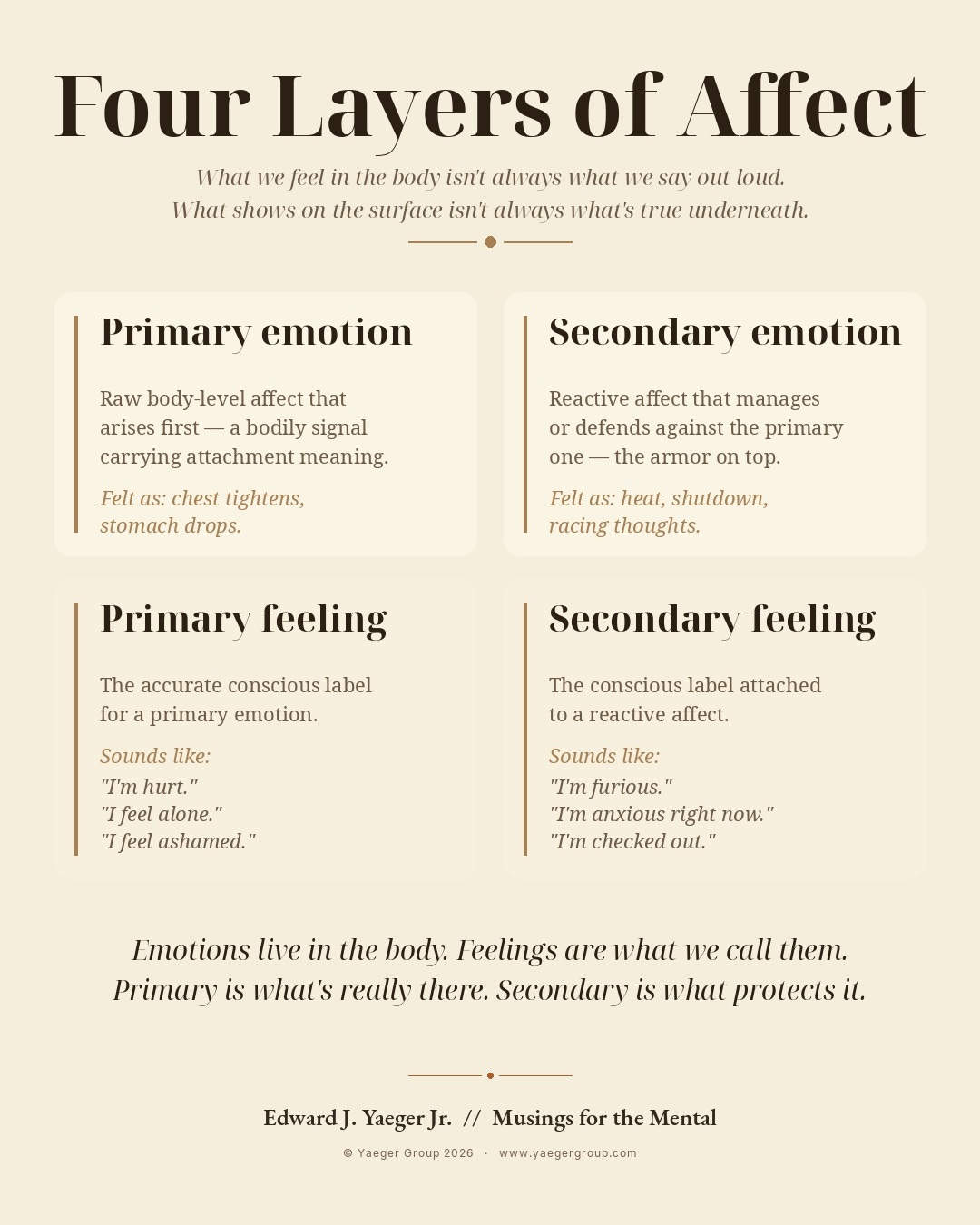
We use emotions and feelings interchangeably, but, in therapy at least, they are not the same thing. (And, per my prior post, neither are primary and secondary emotions or feelings.)
Emotions are what happen in your body, somatically, before your mind has said a word about them (e.g., tightness in your chest, abrupt sinking in your stomach).
Feelings are the labels you put on those body signals: "I'm pissed," "I'm nervous,” “I’m embarrassed," "I'm ashamed."
Primary emotions and feelings are the tender, honest layers underneath, whereas secondary emotions and feelings are the reactive, defensive armors on top.
Primary emotion: What your body registers first = before your mind says a word, your chest tightens, your stomach drops, your breath skips, your face blanches. It is your intuitive self informing you that something of meaning is occurring.
Secondary emotion: What shows up next = your jaw sets, your shoulders brace, your mind blanks, races, or totally shuts down. This is protective armor: still bodily, still fast, but no longer intuitive, as it is designed to shield you from the vulnerability of what the first reactions just signaled.
Primary feeling: What happens when your mind acknowledges the trueness in what you are experiencing = “I’m hurt,” “I’m alone,” “I’m pathetic,” “I’m scared.” These articulations are what make us cry when we finally say them out loud, because naming their realness allows them to be heard and seen.
Secondary feeling: What most of us actually say instead = “I’m anxious,” I’m furious,” “I’m done,” “I don’t care,” “Look what you made me do.” The feelings are real, but it is the armor that is speaking so as to avoid truly feeling. Because feeling these feelings fucking sucks.
Check out this Feelings Wheel to broaden and deepen your own feelings glossary.
Learn how this site works.